
The little visual tool that gives big feelings tiny words.
The moment every parent and teacher knows
You can see it building. Shoulders rise. Jaw sets. Voice gets louder — or suddenly disappears.
You kneel down, soften your voice, and ask the question every loving adult asks:
“What’s wrong, sweetheart?”
And they stare. Or yell. Or crumple. And you think — why can’t they just tell me?
Here’s the gentle truth: in that moment, they genuinely can’t.
When a child is flooded with emotion, the language part of the brain is the first thing to go offline. Asking them to find the right words is like asking someone to read a book in the dark.
They don’t need more words from you. They need a picture 🤍
What is the Incredible 5-Point Scale?
The Incredible 5-Point Scale is a visual regulation tool created by Kari Dunn Buron and Mitzi Curtis. It’s beautifully simple: take any big, abstract experience — anger, anxiety, sensory overload, social energy — and break it into five clear, numbered levels.
A typical emotional scale looks like this:
- ✨ 1 — I feel calm
- ✨ 2 — Something’s bothering me
- ✨ 3 — I’m getting wobbly
- ✨ 4 — I’m close to losing it
- ✨ 5 — I’m in the red zone
Each level gets two companions: a description of what the child’s body feels like at that number, and a list of helpers they can use to support themselves.
The scale becomes a kind of map — one the child can point to, one the adult can reference, one that takes the guesswork out of a hard moment for both of you 🤍
Learn more about the original tool at 5pointscale.com.
🧠 The science: why does something so simple work so well?
It looks like a colourful chart. It’s actually a neurological translator. Here’s what’s happening underneath.
✨ Interoception — feeling what your body is telling you. Interoception is our eighth sense: the ability to notice internal signals like a racing heart, shallow breathing, a tight chest, a hot face. Dr Kelly Mahler’s research has shown that interoceptive awareness is the foundation of emotional regulation. You can’t manage a feeling you haven’t noticed yet. The 5-Point Scale gives kids a structured way to practise noticing — pairing each number with body clues trains the brain to catch the wave earlier.
✨ Co-regulation and the nervous system. Stephen Porges’s polyvagal theory tells us a dysregulated nervous system doesn’t calm through logic — it calms through safety and connection. A visual lets a calm adult meet the child without words, without demands. “I can see you’re at a 4. I’m right here.” That non-verbal bridge is exactly what a flooded brain needs.
✨ Less executive load. For many neurodivergent kids — particularly autistic and ADHD children — every novel demand costs executive function. A scale that looks the same every day, with pre-agreed strategies for each level, reduces the cognitive load in stressful moments. The child doesn’t have to invent a plan mid-meltdown — the plan is already on the fridge.
✨ Evidence in practice. The 5-Point Scale is cited across autism, ADHD and anxiety literature, used in occupational therapy, adapted into school CBT programs, and sits comfortably alongside tools like Leah Kuypers’s Zones of Regulation. It’s not a trend — it’s a quietly powerful, well-researched support 🤍
💭 For parents — at home
The scale works best when it’s a family tool, not a child-management tool. The moment a child senses it’s being used on them rather than with them, the magic dies. Some gentle ways to bring it in:
- ✨ Build it together on a calm day. Pull out paper and snacks, sit on the floor, and fill it in as a team. Their words. Their colours. Their pictures.
- ✨ Model it out loud. “I’m at a 3 right now, I’m going to put the kettle on and breathe.” Children learn regulation the same way they learn language — by hearing us use it, naturally and imperfectly.
- ✨ Use it as a check-in, not a test. Swap “what’s wrong?” for “where are you at?”. A number is so much easier to offer than a sentence.
- ✨ Pair every number with a helper. At a 2, maybe it’s a drink and a stretch. At a 4, a quiet space and a heavy blanket. Pre-agreed strategies remove the decision-making when they need it most.
- ✨ Revisit it every few weeks. Children change. Triggers change. Helpers change. Treat the scale as a living document, not a laminated verdict.
🍎 For teachers — in the classroom
A regulated class learns. A dysregulated class survives. The 5-Point Scale can quietly become one of the most powerful tools in your room.
- ✨ Keep a desk-sized copy for students who need a private, low-demand way to flag where they’re at. A finger pointed at a 3 is easier than a raised hand and an explanation.
- ✨ Use it during transitions — the most dysregulating part of the school day for many neurodivergent learners. A quick check-in before specialist lessons or after lunch can surface what would otherwise become a meltdown by period four.
- ✨ Build a class-wide version. A “noise scale” for group work. An “energy scale” for the afternoon slump. Normalising the idea that everyone has levels makes it feel less like a special tool for the “different” kid.
- ✨ Pre-teach the helpers. Don’t wait for a 4 to discuss what a 4 needs. Teach the strategies during calm moments so the child’s brain can actually absorb them.
- ✨ Normalise every number. A 4 isn’t bad — it’s information. Catching a 4 early is a win.
The child who explodes at lunch isn’t being defiant. They’re at a 5 with no map back down 🤍
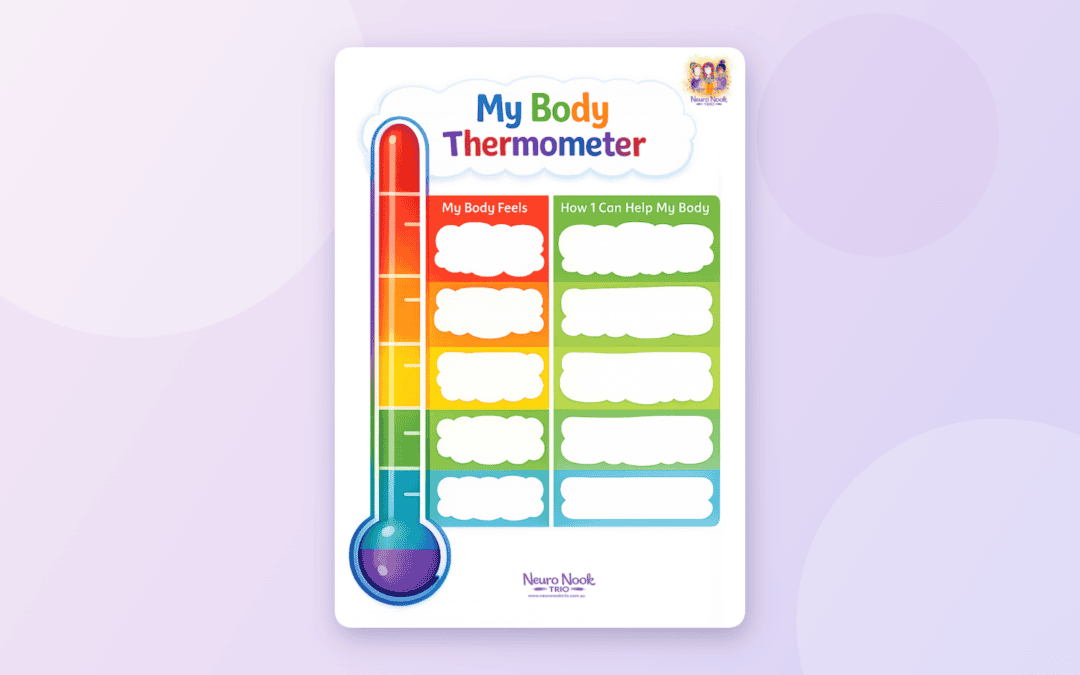
🌡️ Meet our Body Thermometer
Our child-friendly take on the 5-Point Scale is called the Body Thermometer. We designed it with two gentle columns:
- 🧡 What my body feels — the interoceptive clues for each level
- 💚 How I can help my body — the tools, strategies and helpers that match
The thermometer visual makes the scale feel less clinical and more intuitive — feelings can rise, and they can come back down. The colours are calming, neuro-affirming, and match the Neuro Nook palette so it sits on the fridge or classroom wall without adding visual noise.
Print it. Laminate it. Velcro it. Slip it inside a communication folder. It belongs wherever your child or student spends their most dysregulated moments 🤍
A few little reminders before you start
- ✨ Introduce the scale when your child is calm — never mid-storm
- ✨ Let the child own it — their words, their pictures, their strategies
- ✨ Use it with them, not on them — share your own numbers too
- ✨ No number is a bad number. All feelings are welcome here.
- ✨ Celebrate the noticing, not just the managing. Self-awareness is the skill.
🌡️ Download our free Body Thermometer
A printable, neuro-affirming take on the Incredible 5-Point Scale — ready for the fridge, the classroom wall, or the communication folder.