
Using Brain Science and Compassion to Understand and Solve Children’s Behavioural Challenges
Picture this. Your child has just thrown their lunchbox across the kitchen because the sandwich was cut the wrong way. Or they’ve refused to get dressed for the third morning in a row. Or they’ve melted down at pick-up — not over anything you can name, just everything. And you’re standing there thinking: They know better. So why can’t they do better?
That question — that specific, exhausting, guilt-soaked question — is exactly where this book begins. And by the end of it, you’ll understand why it was never the right question to ask.
The shift that changes everything
Most of us were raised in a world that treated behaviour as a choice. Good behaviour gets rewarded. Bad behaviour gets consequences. Simple. Logical. And for some kids, it works well enough.
But for many kids — especially neurodivergent kids — it doesn’t just fail. It makes things worse. The consequences escalate. The meltdowns get bigger. The shame builds. And everyone involved ends up more disconnected than before.
Mona Delahooke, a clinical psychologist with over thirty years of experience working with children and families, offers a fundamentally different way of seeing things. She doesn’t ask “What’s wrong with this child?” She asks “What’s happening in this child’s nervous system?”
That one shift — from behaviour to nervous system — is the heart of this entire book. And it’s the kind of reframe that, once you see it, you genuinely can’t unsee.
What the book is really about
At its core, Beyond Behaviours is about understanding that most challenging behaviours in children aren’t deliberate, wilful, or manipulative. They’re stress responses. The child’s nervous system has detected a threat — real or perceived — and has shifted into survival mode. Fight. Flight. Freeze. Shutdown. What we see on the surface looks like defiance, aggression, withdrawal, or “overreacting.” But underneath, it’s a body that doesn’t feel safe.
Delahooke draws on polyvagal theory, neuroscience, and decades of clinical experience to explain how the autonomic nervous system drives behaviour — often before a child has any conscious awareness of what’s happening. A child in a stress state can’t access reasoning, logic, or the “better choices” we keep asking them to make. Their thinking brain has gone offline. And no amount of consequences will bring it back.
This isn’t a theory that excuses behaviour. It’s a framework that explains it — so we can actually do something useful about it.
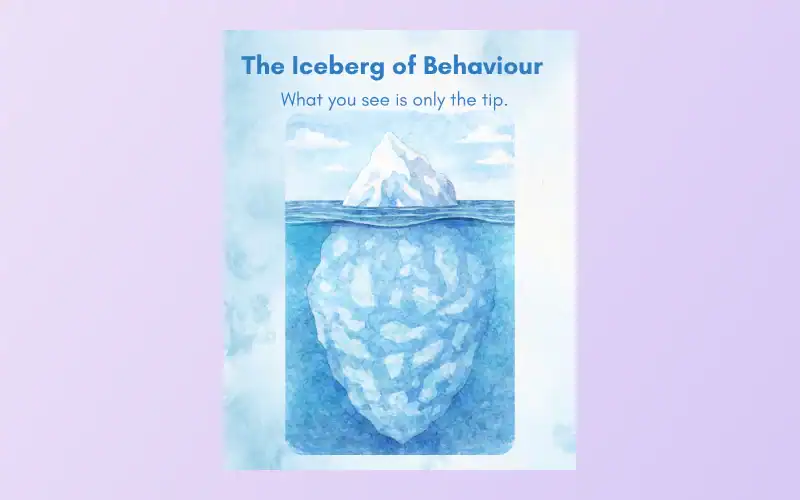
📚 From our Learning Library: The Iceberg of Behaviour — What you see is only the tip →
For parents
If you’ve ever thought “Why do consequences make things worse?” — this book will finally answer that question for you.
If you’ve watched your child melt down over something that seemed tiny — a change in routine, the wrong colour cup, a transition they’ve done a hundred times before — and wondered what you’re missing, Delahooke gently explains what’s really going on. It’s not about the cup. It’s about a nervous system that was already running close to capacity, and the cup was the thing that tipped it over.
She explains behaviour through stress, sensory load, and nervous system overwhelm — not defiance. And that reframe alone can be enough to change the entire dynamic in your home. Your child isn’t giving you a hard time. They might be having a hard time.
What makes this book genuinely practical — not just theoretical — is how much it gives you to work with. There are guided questions to help you reframe tough moments in the heat of it. Scripts and prompts that prioritise regulation over reaction. And an entire section dedicated to supporting yourself as a parent — because co-regulation starts with us.
That last part doesn’t get talked about enough. Delahooke is clear: you can’t regulate a child if your own nervous system is in overdrive. When we understand our own stress patterns — our own triggers, our own fight-or-flight moments — we respond differently. We show up differently. Sometimes the most important shift isn’t “How do I stop this behaviour?” It’s “What does my child need right now?” and “What do I need right now to show up calmly?”
Those two questions, held together, are worth the entire book.
For teachers
If there’s one thing this book asks educators to sit with, it’s this: are we mistaking stress responses for disrespect?
It’s a hard question. And Delahooke doesn’t ask it to blame anyone. She asks it because the answer matters — and because the traditional tools we’ve been given in education often aren’t equipped for the kids who need the most support.
This isn’t about lowering expectations. It’s about understanding capacity. A child who is dysregulated — whose nervous system is in survival mode — cannot access the skills we’re asking them to use. They can’t sit still, listen carefully, follow multi-step instructions, manage their emotions, or make thoughtful choices. Not because they won’t. Because, in that moment, they can’t. The wiring that supports those skills has temporarily gone offline.
So the question becomes: are we asking for skills before regulation? Are behaviour charts addressing the root cause — or just the surface? Are we building felt safety in our classrooms, or are we building compliance and hoping safety follows?
Hard questions. Important ones.
A professional reflection
This book invites educators to view behaviour through a nervous system lens. To learn to recognise stress states — fight, flight, freeze, and shutdown — for what they actually are, rather than what they look like from the outside. To rethink traditional reward and consequence systems that may work for regulated children but actively harm dysregulated ones. And to build felt safety before expecting compliance — because a child who doesn’t feel safe in their body cannot learn, no matter how well-designed the lesson.
“What does this child’s body need right now?”
The guiding question Delahooke offers is one worth writing on a sticky note and keeping on your desk.
This book is a treasure trove of scaffolds and guided questioning to help understand and support student behaviour. Not as a quick fix, but as a way of seeing — and once you see it, everything in your classroom looks different.
Why this book stays with you
There are parenting and education books that give you strategies. And there are books that change the way you see. Beyond Behaviours is the second kind — and that’s what makes it so powerful.
It doesn’t hand you a checklist or a seven-step program. It rewires the lens through which you interpret your child’s most difficult moments. And once that lens shifts — from “they’re choosing this” to “their body is telling me something” — you can never quite go back to the old way of seeing it.
The meltdown in the supermarket stops being embarrassing and starts being information. The morning refusal stops being defiance and starts being a nervous system that isn’t ready yet. The child who “should know better” becomes a child whose body got there before their brain could catch up.
And in that shift, something else happens too. The guilt lifts — just a little. Because you realise it was never about doing it wrong. It was about not having the right map.
Keep exploring — related from the Learning Library
This book is the map.
Your child isn’t giving you a hard time. They’re having a hard time. And this book will help you meet them there — with compassion, with science, and with the quiet confidence that comes from finally understanding what’s really going on beneath the surface. 🤍