
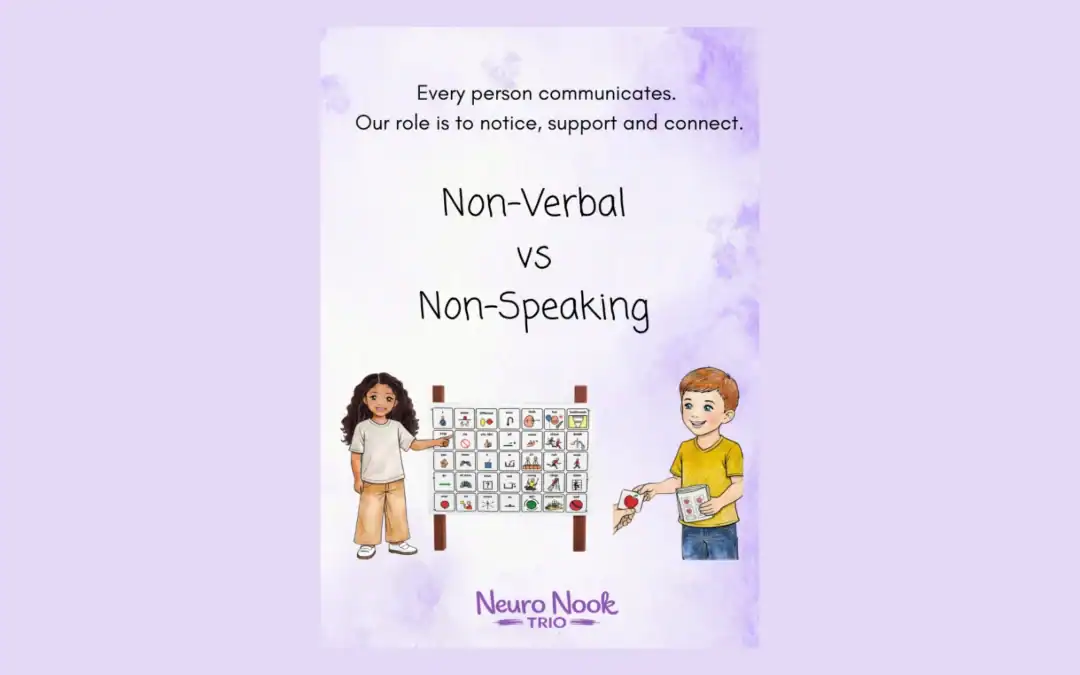
You ask a question. You wait. Maybe you try again… a little slower this time.
They don’t respond the way you expected. No words. No clear answer. Maybe just a look, a movement, or nothing at all.
And it’s easy to wonder — are they understanding?
Here’s the shift: communication isn’t always spoken — but it’s always there.
What do we mean by non-verbal and non-speaking?
These words are often used interchangeably, but they don’t mean the same thing.
Non-verbal typically describes someone with limited access to spoken and symbolic language. Communication might be through actions, sounds, facial expressions, or body language.
Non-speaking means a person does not use speech as their main way to communicate — but understanding and language are still there.
They have thoughts, ideas, and meaning — just expressed differently.
What does communication look like?
It might be:
- Gestures or body movement
- Sounds or vocalisations
- Facial expression
- Pointing, reaching, or showing
- Using visuals, devices, or other supports
Communication doesn’t disappear — it adapts.
Why does language matter?
The words we choose shape how we understand a person.
Using the term non-speaking:
- Recognises competence and understanding
- Separates speech from thinking
- Reminds us there is always something to say
- Encourages us to look for how someone communicates
It shifts the focus from what’s not there… to what is.
Who is it for — and why does it matter?
Everyone.
Because understanding these terms changes how we see and respond to communication.
When we recognise the difference:
- We don’t underestimate someone’s understanding
- We separate speech from thinking and ability
- We become more responsive to how a person is communicating
- We create more respectful, inclusive interactions
Communication is shared. It’s shaped by the people around the individual — those who notice, interpret, and respond in ways that support connection.
And when we shift our understanding, we make space for communication to be seen, heard, and valued in all its forms.
How to support
Slow down and observe.
Notice what the person is already doing to communicate. Respond to those attempts. Offer different ways to express — visuals, gestures, AAC, or sign.
Connection grows when we meet communication where it is.
A gentle reminder
There is always communication.
Sometimes we just need to look a little differently to see it.
Continue exploring with us
To deepen your understanding, you might explore: