
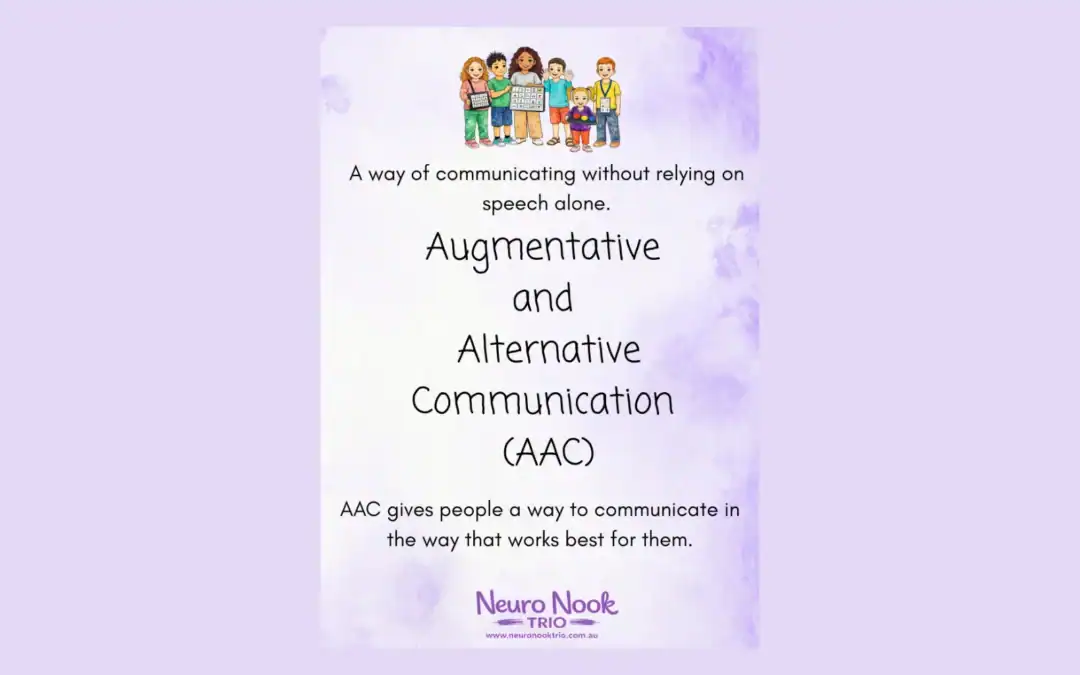
AAC stands for Augmentative and Alternative Communication.
It’s a way of communicating that doesn’t rely on speech alone.
AAC can support speech (augmentative) or provide another way to communicate (alternative). It gives people access to communication in the way that works best for them.
What does AAC look like?
AAC is not just one thing — it includes a wide range of ways to communicate.
It might look like:
- Gestures, signs, or Key Word Sign
- Facial expressions and body language
- Communication boards or books
- Picture systems (like PECS)
- Switches or buttons
- Devices with communication apps
- Text-to-speech or voice output devices
- Eye-gaze systems
AAC can be simple, high-tech, or anything in between. And often, people use a combination of methods depending on the moment.
Why does it matter?
AAC opens up communication.
It supports people to:
- Express wants, needs, thoughts, and feelings
- Understand what’s happening around them
- Connect with others
- Participate in learning, play, and everyday life
When communication is accessible, everything else becomes more accessible too.
Who is it for — and why does it matter?
Anyone who benefits from support with communication.
This includes:
- Non-speaking individuals
- People with limited or unreliable speech
- Children developing communication
- Anyone who needs another way to express or understand
Understanding AAC matters because it shifts our role. Instead of waiting for speech, we support communication in all its forms.
And that’s where connection grows.
Supporting communication in everyday moments
Start by paying attention.
Notice how the person is already communicating — through their body, their expressions, their actions, their sounds. Meet those moments with a response. That’s where connection begins.
From there, you can add support in simple, natural ways. Offer choices, use visuals, or pair a sign with your words to make meaning clearer and more accessible.
AAC works best when it’s part of everyday life — during play, routines, conversations, and shared experiences.
If you’re working with a speech pathologist, follow their guidance and use the supports they’ve recommended consistently across environments.
To engage with someone who uses AAC:
- Give them time to respond
- Be patient and present
- Watch how they communicate and follow their lead
- Respond to all communication attempts — not just spoken words
- Speak directly to them and include them in interactions
And if you’re building your understanding, spend time alongside children and adults who use AAC. Observe, interact, and stay curious.
Because communication isn’t about how it looks — it’s about connection.
Continue exploring with us
To deepen your understanding of the diverse ways of communication, explore Neuro Nook Trio’s resources. We’ll continue to share a range of AAC approaches — and as a starting point, you might like to explore Key Word Sign.