
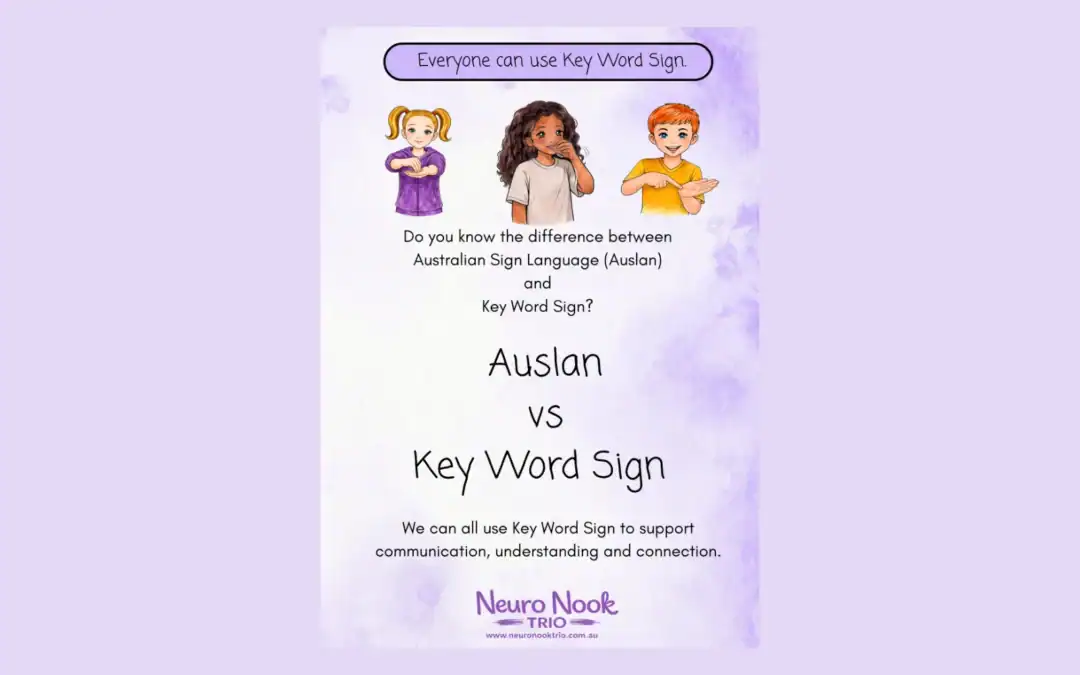
Auslan is a complete language used by the Deaf community. It has its own grammar, sentence structure, and rules — different from spoken English.
Key Word Sign is a communication approach. It uses signs (often from Auslan), alongside speech, to support understanding and expression.
You say the full sentence — and sign the key words.
What’s the difference?
Auslan:
- A full, independent language
- Its own grammar and structure
- Not based on spoken English
Key Word Sign:
- A support for communication (not a language)
- Follows spoken English word order
- Signs only the important words
- Uses speech, gesture, and facial expression together
Same signs — different purpose.
Why does this matter?
Understanding the difference helps us use each approach respectfully and effectively.
- It honours Auslan as a rich, complete language
- It helps us use Key Word Sign in the way it’s intended
- It supports clearer communication for the person we’re working with
- It builds more inclusive and informed practice
When we know the difference, we use it with purpose.
Who is it for?
Everyone.
Key Word Sign can support children and adults who experience challenges using speech, as well as the people around them — parents, educators, carers, and peers.
Because communication is shared.
How to use Key Word Sign
Use signs as you speak.
Focus on the key words. Use it in everyday moments — routines, play, and connection.
Start small. One or two signs used consistently can make a meaningful difference.
You don’t need to learn everything at once.
Connection grows through small, repeated, shared moments.
Continue exploring with us
To deepen your understanding, explore Neuro Nook Trio’s resources on AAC and Key Word Sign, including our set of 12 everyday key word signs with clear visuals and simple descriptions. These are designed to be used in real, everyday moments to support communication and build more inclusive interactions.